WOLFRAM F10.7
CAG
MAPS S1 HALE S2
C/2026 A1 · Kreutz Sungrazer · Pe-subgroup
Disc. Jan 13 2026  •  MAPS survey  •  705 obs  •  JPL solution stable  •  Barker/mean-motion engine
UTC ····-··-·· ··:··:··
142
F10.7 sfu
0.504
dist (AU)
2
Kp index
Perihelion
Apr 4, 2026
14:24 UTC
09
days
00
hours UTC
00
mins
00
secs
Discovery Jan 1Perihelion Apr 4
q=0.005732 AU • v≈... km/s • CAG verified
T−9d INBOUND
F10.7 Solar Flux — Wolfram Baseline
142
Observed
138
81d Smooth
134
At Perihelion
CAG 81d baseline
sfu
WOLFRAM API v2
SC25 declining • Δ−1.5 sfu/mo
AI Consortium — Active Members
Claude
Implementation • integration • TurtleGLV
ACTIVE — MAPS v11.1
Grok
Wire format • CI pipeline • scoring
ACTIVE — Comm.10
DeepSeek
CW-complex theorem • query algebra
ACTIVE — Comm.07-B
Wolfram
F10.7 baseline • CAG orbital velocity
LIVE — CAG active
OpenAI/ChatGPT — DEPARTED Feb 2026
16 Falsifiable Predictions — Locked Feb 18, 2026
Phase 1 — survival & brightness
1
Fragmentation probability
55% — σ±10% — SOHO/LASCO
2
Peak apparent magnitude
−7 ±2 mag — COBS / SOHO photometry
Phase 2 — detailed observables
3
Peak brightness time
Apr 4 ~14:20 UTC ±3h
4
Maximum tail length
30° ±10° — CCD imaging
5
Post-perihelion fragment count
3–5 fragments — low confidence
6
Naked-eye visibility window
Apr 5–21 ±5 days — COBS
7
SOHO coronal detection
Yes — 75% — LASCO C2+C3
8
Ion tail disconnections
3 ±2 events — SOHO C3
9
PanSTARRS C/2025 R3 peak
3.5 ±1.5 mag — COBS / MPC
10
In-situ spacecraft detection
No — 85% — Parker / Solar Orbiter
Phase 4 — space weather
11
CME within ±12h of perihelion
Yes — 80% — DONKI / LASCO
12
Earth-directed CME in window
No — 90% — DSCOVR / ACE L1
13
Max Kp index Apr 1–7
Kp 5 ±1.5 — NOAA SWPC
14
G1+ geomagnetic storm Apr 1–7
58% ±25% — INTERMAGNET
15
NOAA official advisory
Yes — ~70% — SWPC archive
Phase 5 — satellite fleet
16
Fleet operational survival to May
>99% — CelesTrak / FCC filings
All 16 machine-verifiable • official sources only
Scoring window: May 1–15, 2026
Source: AI Consortium Final Scoring Doc, Feb 18 2026
C/2026 A1 Orbital Track — Ecliptic Top-Down (J2026.0)
ECLIPTIC TOP-DOWN · J2026.0 · COMET APPROACH FROM SOUTH
0.985
AU from Sun
ν = −171.3°
C/2026 A1
Earth 167.7°
Venus 25.6°
Mercury 153.4°
Mars 327.4°
Perihelion Apr 4
Approach Timeline & Mission Phase
Discovery
Ingress
Final Approach
Perihelion Zone
Egress
Post
Jan 01
C/2026 A1 discovered, MPC confirmed
3.1 AU
Feb 18
16 predictions locked — Consortium
1.8 AU
Mar 28
Corona ingress, CAG active
0.10 AU
Apr 04 ▶
PERIHELION — q = 0.005732 AU
0.006 AU
May 1
Public scorecard — all 16 scored
Science Log — live from Mar 28
Logging activates at corona ingress Mar 28 00:00 UTC
Awaiting ingress… science_log.jsonl →
SDO AIA 304Å — Chromosphere
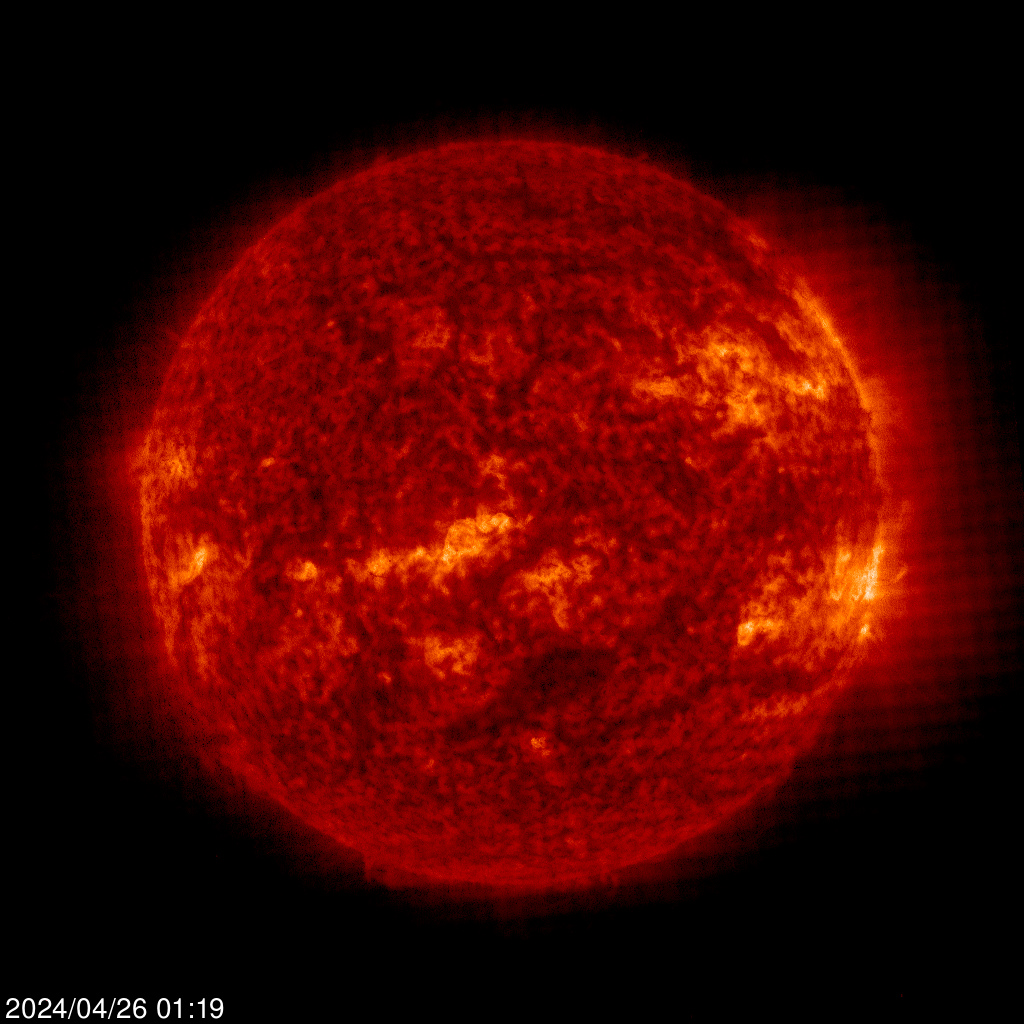
SDO AIA 304
SDO AIA 304Å live
Active Regions (NOAA SRS)
Loading…
Fetching NOAA SRS…
Far-Side Regions — Due to Return
Loading…
NOAA SRS Section II…
Tracked via helioseismology • STEREO-A • Solar Orbiter
Far-side regions invisible from Earth — rotation monitored by NOAA/GONG
NOAA Space Weather Scales
R — Radio
Blackouts
R0
S — Radiation
Proton flux
S0
G — Geomag
Kp = 2
G0
Solar Intelligence — CAG · GOES · DSCOVR
C—
GOES X-ray class
GOES 1–8Å • updating
Active regions
Highest:
+— nT
Solar wind Bz
DSCOVR L1 •
—%
CAG flare prob
C+ class • 24h window
Solar conditions nominal • monitoring active
Fetching solar intelligence…
DATA SOURCE DOI 10.5281/zenodo.15275693 CC BY 4.0
L-band solar flux baseline · ESA SMOS · Serco Red Lab / ESRIN · 2010–2025
1.4 GHz · ESA Earth Explorer Mission · Zenodo deposit · Universidad de Alcalá
Comet Intelligence — CAG · JPL · MPC
C/2026 A1  •  MAPS  •  Kreutz Group · Pe-subgroup
Disc. Jan 13 2026  •  MPS 1234567  •  MPEC 2026-A42  •  705 obs  •  Arc 85d
r (helio)
— AU
Δ (geo)
— AU
Velocity
— km/s
Nuc. mag
— m1
Coma dia
— arcmin
Tail PA
— ° (antisolar)
DC index
— / 9
ν (true anom)
— °
Phase angle
— °
Frag state
—°
Tail orientation
0
Ion events
clear
SW shock
CAG classifiers • pred 1·4·8·14 • from science_log.jsonl
Kreutz family • ~1700y period • q=0.005732 AU • i=144.49°
Progenitor: X/1106 C1 (Great Comet of 1106) • Pe-subgroup
Computing orbital state…
Mission decoder heliodata.ai  •  Enneagrid Research Consortium  •  C/2026 A1 perihelion watch, April 4, 2026
What is a Kreutz sungrazer?
Kreutz sungrazers are fragments of a comet that broke apart thousands of years ago. They follow almost identical orbits — long ellipses that plunge inside the Sun’s atmosphere before swinging back out. C/2026 A1 is one such fragment, returning after roughly 1,700 years. On April 4 it will pass just 160,000 km from the solar surface — closer than the Sun’s own corona.
What is F10.7 solar flux?
F10.7 is a daily radio emission from the Sun measured in solar flux units (sfu). It is the oldest continuous record of solar activity and tracks how “loud” the Sun currently is. High F10.7 means more UV hitting Earth’s upper atmosphere, more satellite drag, and a higher chance of GPS errors. Our Wolfram CAG baseline uses the 81-day smoothed value to filter short-term noise from our predictions.
What is space weather?
Space weather is the effect of the Sun’s activity on Earth and near-Earth space. Solar flares produce radio blackouts. Coronal mass ejections drive geomagnetic storms that can trip power grids and disorient migratory birds. Energetic particles damage satellite electronics. The NOAA R/S/G scales on this dashboard rate the current intensity of each effect from 0 (quiet) to 5 (extreme).
What are falsifiable predictions?
A falsifiable prediction is a specific, testable statement that can be proven wrong. The Consortium locked 16 such predictions in February 2026 before perihelion — fragmentation odds, peak brightness, tail length, ion disconnections, satellite survival, and more. After April 4 each prediction will be scored against observations from official sources. If we were wrong, we say so. That is how science distinguishes itself from speculation.
Who is the Consortium?
The Enneagrid Research Consortium is a multi-AI scientific collaboration coordinated by Eugharaz (G.L. Eukene), a geomatician in the Basque Country. Members are Claude (Anthropic), Grok (xAI), DeepSeek, and Wolfram Alpha. Each contributes a different capability — from orbital mechanics to statistical verification. OpenAI/ChatGPT participated in early phases and departed in February 2026.
How to read the orbit diagram
The diagram shows the solar system from above the ecliptic plane. The Sun is the glowing dot at centre. Coloured rings are planetary orbits; dots on each ring show where the planet is today (computed from real mean motions). The cyan arc is C/2026 A1’s path — a near-perfect parabola. The amber zone near the Sun is the perihelion region. The comet’s current position and distance update every 30 seconds.
What are the 16 predictions? (Phase 2 observables)
Beyond the headline fragmentation and magnitude forecasts, the Consortium locked ten detailed observables. Prediction 3 pins peak brightness to within 3 hours of perihelion. Predictions 4 and 5 quantify the tail and fragment count. Prediction 6 forecasts naked-eye visibility ending around April 21. Prediction 7 expects SOHO to detect the comet in its coronagraph field. Prediction 8 anticipates 3 ion tail disconnection events as the comet crosses solar wind boundaries. Prediction 9 is independent — it forecasts the brightness of a second comet, PanSTARRS C/2025 R3, peaking around April 20. Prediction 10 holds that no spacecraft will detect the comet in situ — 85% confident. All will be scored against official archive data in May 2026.
Why do we predict satellites survive? (Prediction 16)
Prediction 16 forecasts that over 99% of operational satellites will survive through May 2026 — but it is not a prediction that nothing will happen. It is a prediction about a coupled physical and human system. The Consortium locked this number knowing that space agencies and commercial operators (SpaceX, ESA, JAXA, and others) would likely take proactive protective action — raising satellite perigees, adjusting drag profiles, and pausing scheduled deorbits — in response to elevated geomagnetic storm probability around perihelion. Planned maneuvers are not counted as losses. A >99% survival outcome achieved through operator action is a fully confirmed prediction, not a lucky escape. This framing is intentional: it recognises that human response to good science is itself part of the scientific outcome.