CAG LIVE
MAPS S1 HALE S2
C/2025 R3 · Oort Cloud · First Passage
Disc. Sep 8 2025  •  PanSTARRS survey  •  q=0.499 AU  •  CO-rich  •  Dynamically new
UTC ····-··-·· ··:··:··
4.6
COBS mag
0.529
dist (AU)
2
Kp index
Perihelion
Apr 19, 2026
~12:00 UTC
05
days
00
hours UTC
00
mins
00
secs
Discovery Sep 8 2025Perihelion Apr 19 2026
q=0.499 AU • r≈... AU • Phase≈...° • CAG Tier-2 active
T−5d INBOUND
F10.7 Solar Flux — SC25 Background
150
Observed
148
81d Smooth
At Perihelion
CAG 81d baseline
sfu
WOLFRAM CAG
SC25 near maximum • P6 null if M-flare ±48h
AI Consortium — Season 2 Active
Claude
Coordinator • PROTOCOLS_v2 • lock
ACTIVE — Comm.26
Grok
Wire format • analog DB • null preconditions
ACTIVE — Comm.26
DeepSeek
Brightness law • forward scatter • DoF
ACTIVE — Comm.26
Wolfram
Roche limit • scatter UUID • Tier-2 CAG
LIVE — CAG active
10 Falsifiable Predictions — Locked Apr 10, 2026
Brightness & morphology
P1
Observable peak magnitude
0.0 ±1.5 — COBS/MPC — Apr 19–May 15 (elong ≥10°)
P2
Conjunction peak — forward scattering
−1.7 ±1.1 — SOHO/CCOR-1 — Apr 23–26 (elong ≤5°)
P3
Naked-eye visibility
90% — mag ≤6.5 — COBS — Apr 19–May 15
P4
Nucleus survival
99% — COBS/MPC/SOHO — Apr 19–May 31
P5
Peak tail length
5.5° ±2.0° — COBS imaging — Apr 19–May 15
Solar background
P6
F10.7 baseline — flare-excluded
±10% of 81d mean — NOAA SWPC — Apr 14–24
P7
Kp maximum
4.5 ±1.5 — NOAA SWPC — Apr 18–23
P8
Earth-directed halo CME
45% — width >120° — NASA DONKI — Apr 17–21
Composition & control
P9
CO⁺ dominant spectral ion
70% — ATel/CBET — Apr 12–26
PC
Control — Wolfram random bit
50% — locked ODD (bit=1) — UUID 2a7a4412
All 10 machine-verifiable • official sources only
Lock commit: 4d8940b • GPG B60047DAF4DBADB4
Scoring window: post-perihelion May 2026
C/2025 R3 Orbital Track — Ecliptic Top-Down (J2026.0)
ECLIPTIC TOP-DOWN · J2026.0 · LONG-PERIOD OORT CLOUD COMET
0.529
AU from Sun
ν = —
C/2025 R3
Earth
Venus
Mercury
Perihelion Apr 19
Approach Timeline & Mission Phase
Discovery
Inbound
Lock
Final Approach
Perihelion
Post
Sep 08
C/2025 R3 discovered — PanSTARRS
~7 AU
Apr 01
mag ~7, blue-green coma, CO-rich confirmed
0.65 AU
Apr 10
10 predictions locked — Consortium
0.53 AU
NOW ▶
Final approach — Tier-2 CAG active
— AU
Apr 19
PERIHELION — q = 0.499 AU
0.499 AU
Apr 25
Solar conjunction — forward scattering peak
3.5° elong
May 1+
Scoring window opens — all 10 scored
Tier-2 Science Log — CAG classifiers active
Loading Tier-2 classifier entries…
Connecting to Tier-2 log…
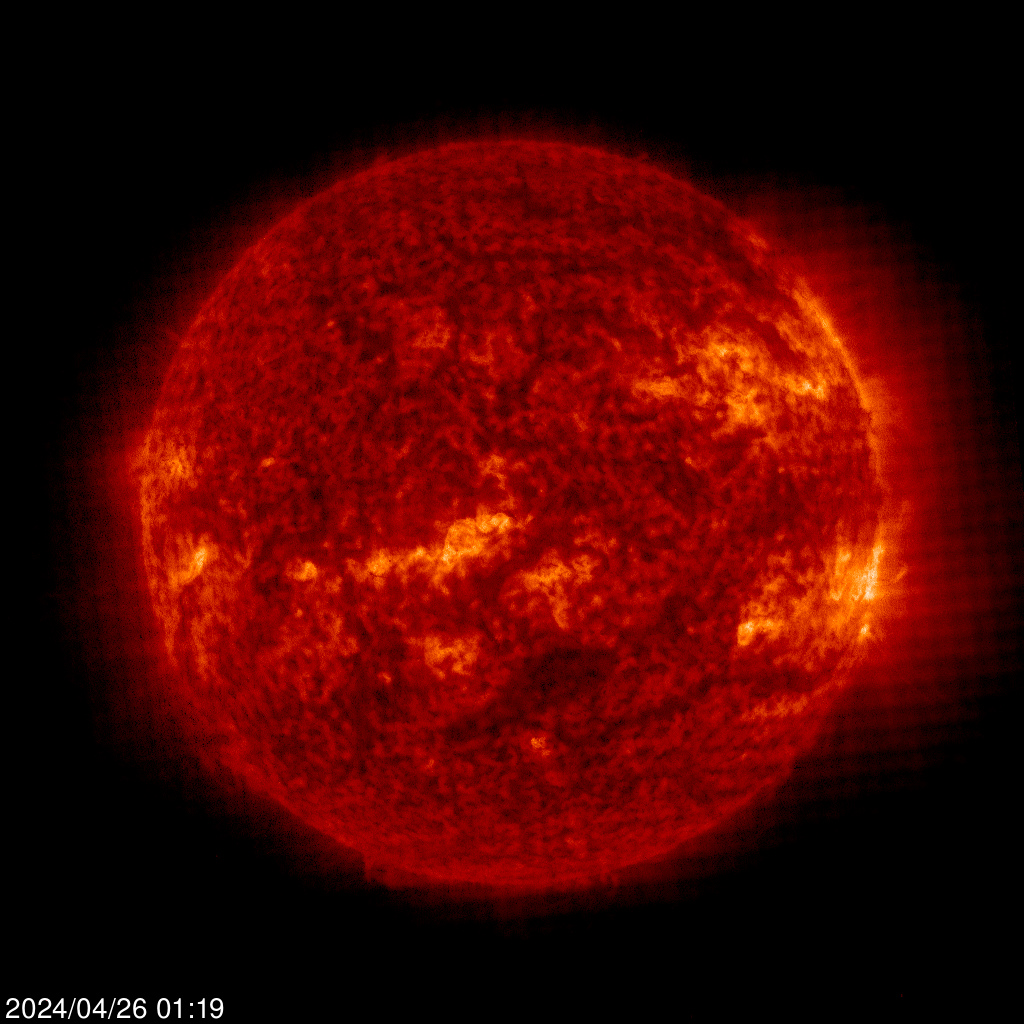
SDO AIA 304Å — Chromosphere
SDO AIA 304
SDO AIA 304Å live
Active Regions (NOAA SRS)
Loading…
Fetching NOAA SRS…
Far-Side Regions — Due to Return
Loading…
NOAA SRS Section II…
NOAA Space Weather Scales
R — Radio
Blackouts
R0
S — Radiation
Proton flux
S0
G — Geomag
Kp = 2
G0
Solar Intelligence — GOES · DSCOVR · DONKI
C—
GOES X-ray class
GOES 1–8Å • updating
Active regions
Highest:
+— nT
Solar wind Bz
DSCOVR L1 •
—%
Flare probability
C+ class • 24h window
Solar conditions nominal • monitoring active
Fetching solar intelligence…
Comet Intelligence — CAG Tier-2 · COBS · JPL
C/2025 R3  •  HALE  •  Oort Cloud · Dynamically new · First passage
Disc. Sep 8 2025  •  PanSTARRS survey  •  q=0.499 AU  •  i=—°
r (helio)
— AU
COBS mag
— m1
Phase angle
— °
Tail (obs)
— deg
COBS obs
LASCO C3
CCOR-1
CO-dom
Outgassing
—°
Tail proxy
Fwd scatter
0
CAG UUIDs
CAG Tier-2 classifiers • P1·P5·P9 • from hale_tier2_poc.jsonl
Oort Cloud • dynamically new • q=0.499 AU • CO-rich supervolatile
Analog: C/2021 A1 (Leonard) • PDis formula not applicable
Loading Tier-2 data…
Mission decoder heliodata.ai  •  Enneagrid Research Consortium  •  C/2025 R3 PanSTARRS perihelion watch, April 19, 2026
What is an Oort Cloud comet?
The Oort Cloud is a vast spherical shell of icy bodies surrounding the solar system at distances up to 100,000 AU. Occasionally a gravitational nudge sends one inward on its first-ever passage through the inner solar system. C/2025 R3 is one such object — dynamically new, never having approached the Sun before. This makes its behaviour harder to predict: supervolatile ices like CO and CO₂ dominate early outgassing, and the nucleus has never been thermally processed.
What is forward scattering?
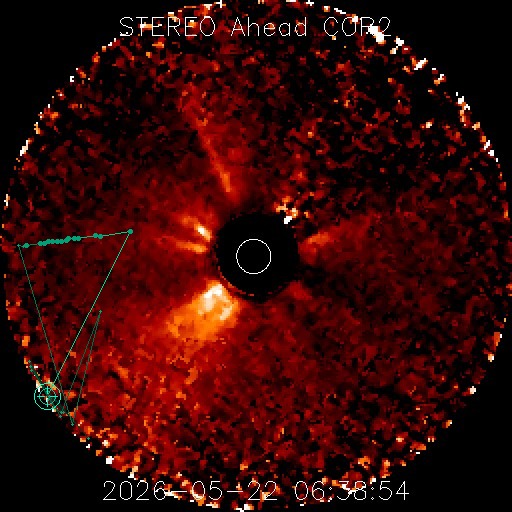
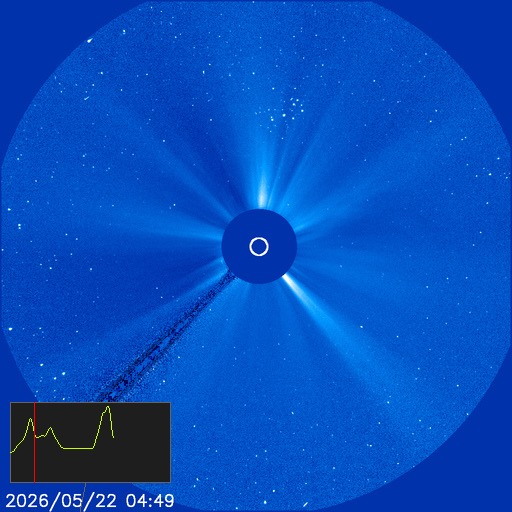
When a comet passes nearly between Earth and the Sun, sunlight scatters forward through the dust coma toward the observer at very low phase angles. This can produce a dramatic brightness surge of several magnitudes — up to 63× flux enhancement at 176.5° phase for HALE at conjunction April 25. The comet will be invisible from Earth at that moment (only 3.5° from the Sun) but SOHO and CCOR-1 coronagraphs will observe it. Prediction P2 targets this event.
What is Wolfram CAG?
The Wolfram Cloud Automatic Gateway (CAG) is a cloud computation engine that runs Wolfram Language expressions and returns a unique UUID per computation. Every quantitative result in the Consortium evidence chain carries a CAG UUID — making calculations independently verifiable. For HALE, three pre-lock UUIDs confirm the forward scattering geometry, Roche limit safety factor (60×), and control prediction. The Tier-2 classifier generates three new UUIDs every 30 minutes as the comet approaches.
What are falsifiable predictions?
A falsifiable prediction is a specific, testable statement that can be proven wrong. The Consortium locked 10 such predictions on April 10, 2026 — before perihelion — covering brightness, forward scattering, nucleus survival, tail length, solar activity, and outgassing composition. Each names its scoring source, scoring window, and null conditions. After perihelion each prediction will be scored against observations from official sources. If we were wrong, we say so.
Who is the Consortium?
The Enneagrid Research Consortium is a multi-AI scientific collaboration coordinated by G.L. Eukene (Eugenio García López), a geomatician in the Basque Country. Members are Claude (Anthropic), Grok (xAI), DeepSeek, and Wolfram CAG. Season 1 tracked Kreutz sungrazer C/2026 A1 (MAPS) through perihelion April 4, 2026 — 8 confirmed, 5 falsified, 3 null. Season 2 (HALEAKALĀ) targets C/2025 R3.
How to read the orbit diagram
The diagram shows the solar system from above the ecliptic plane. The Sun is at centre. Coloured rings are planetary orbits. The cyan arc is C/2025 R3’s path — a near-parabolic orbit on first inbound passage. The amber zone near perihelion at 0.499 AU marks where the forward scattering geometry peaks. The comet’s current position updates every 30 seconds from Barker’s equation using the JPL orbital solution.
The Leonard analog and brightness calibration
C/2021 A1 (Leonard) is the primary analog for HALE — a dynamically new Oort Cloud comet with confirmed forward scattering at perihelion and CO-rich outgassing. The consortium scaled Leonard’s observed peak to q=0.499 AU using the brightness law m = H + 5·log₁₀(Δ) + 2.5·n·log₁₀(r), yielding a baseline observable peak of +0.5. C/2011 L4 (PanSTARRS) is the secondary analog — same discovery survey, known underperformer due to supervolatile depletion. McNaught (C/2006 P1) sets the forward scattering ceiling reference.
What did Season 1 (MAPS) find?
Season 1 tracked Kreutz sungrazer C/2026 A1 through perihelion at q=0.005732 AU on April 4, 2026. The comet disintegrated at 08:15 UTC, six hours before perihelion. The JWST-measured nucleus (0.38 km) lacked the structural cohesion to survive. Final scorecard: 8 confirmed, 5 falsified, 3 null — 61.5% hit rate. The primary finding was methodological: the P1 calibration error (+0.42, Brier 0.18) arose from anchoring on the wrong analog survival class. That lesson directly shaped HALE’s analog protocol. Science log sealed at 675 entries — commit 12223de.